
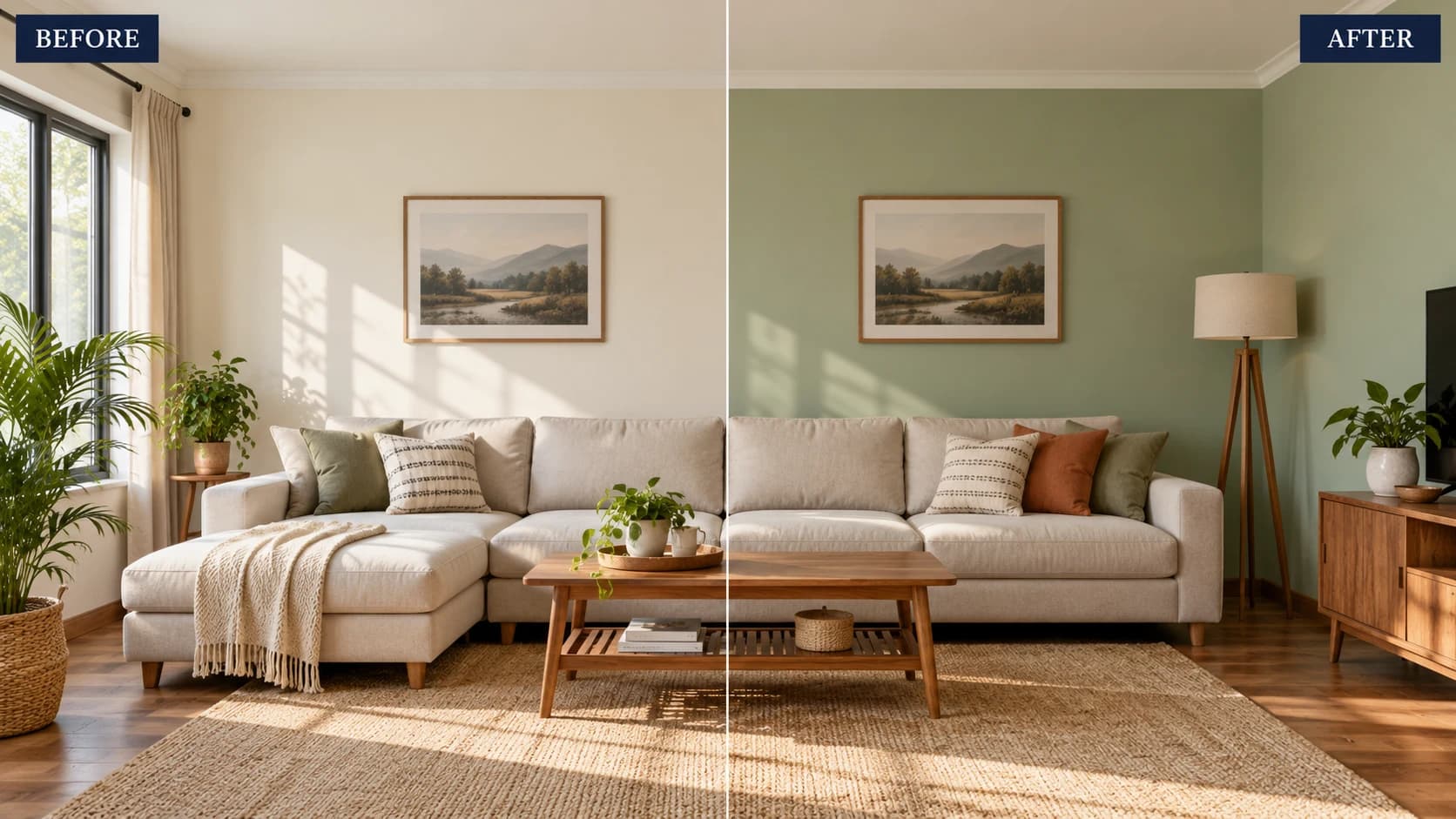
Paint covers much of what you see in a finished home. A shade that looked calm on a 2-inch chip at the hardware shop can look much stronger across a three-storey facade. A white exterior can make rain streaks and dust more visible. A dark accent wall can make a north-facing bedroom feel smaller.
The fix is simple: choose colours for Nepal's conditions, use real shade codes so the dealer mixes exactly what you saw, and preview the colour on a photo of your actual house before a single litre is tinted.
This guide gives you all three: practical exterior colour advice, room-by-room interior ideas and shade codes from Asian Paints and Berger Paints Nepal catalogues. Try colours on your own photo in our free paint visualizer, then take your shortlist to a local dealer to confirm shade availability, the right product and the finish you need.
The Short Answer
If you want a quick decision:
- Exterior, Kathmandu Valley: a warm mid-light neutral body with a darker plinth band. Pure white can make dust and rain streaks more visible.
- Exterior, Terai: light, warm colours that reflect heat. Keep dark colours to small accents.
- Interiors: light warm whites and soft neutrals for most rooms, with one accent wall in living rooms or bedrooms.
- Before you buy: preview the shade on a photo of your house, then paint a 1 m x 1 m test patch and look at it in morning and evening light.
Why Choosing House Colours in Nepal Is Different
Colour advice written for Europe or the US often fails here. Four local conditions change the answer:
1. Dust and pollution. Kathmandu Valley roads, construction and brick kilns put fine dust on every surface. Bright white and very pale exteriors show it within months. Mid-light neutrals (beige, greige, stone, sage) hide it far better.
2. The monsoon. From June to September, rain splashes mud onto the bottom metre of every wall, and shaded north and west faces stay damp long enough for algae and fungus to grow. A darker plinth band and an anti-fungal exterior paint solve most of this.
3. Strong sun. UV at Kathmandu's altitude, and the heat in the Terai, fade strong colours faster, especially deep reds, oranges and bright blues on south and west faces. Dark colours also absorb heat, which matters in Biratnagar, Birgunj, Bhairahawa and Nepalgunj far more than in Kathmandu.
4. Mixed facades. Many Nepali houses combine plaster, exposed brick, stone cladding and grey concrete projections. Your paint colour has to work with the materials you are not painting.
One more practical point: in heritage areas such as the historic cores of Bhaktapur, Patan and Kathmandu, facade guidelines can restrict materials and colours. Check with your municipality before you choose a bold exterior there.
Exterior House Colour Ideas for Nepal
Start with the materials already on your house: exposed brick, stone cladding, windows and the roof. Choose a main wall shade that sits comfortably beside them, then use a smaller accent area and lighter trim to define the elevation.
Plaster and exposed brick: warm off-whites, beige and greige are useful starting points. Compare their undertones against the brick and floor tiles before you commit.
Gardens and natural surroundings: muted sage, stone-grey and warm neutral walls can sit comfortably alongside planting, timber and stone. Check the colour in both direct sun and shade.
Hot, sunny districts: begin with lighter exterior shades and keep darker colours to details. Ask your dealer about the specific exterior product and shade's suitability for your house's sun and weather exposure.
Lower walls and trim: consider a darker plinth band for splash marks, and a lighter trim for parapets or slab edges. The coating system and surface preparation matter alongside the colour.
Upload a daylight photo to the paint visualizer, select the exterior walls and search by shade name or code. The preview keeps the photo's light and shadow. Confirm the final choice with a physical shade card and a test patch.
Exterior Painting Tips for Nepal's Climate
Paint after the monsoon, or before it. October-November and February-May are the most reliable windows. Avoid the monsoon. In winter, check the minimum application temperature printed on the tin, because Kathmandu nights can drop close to freezing.
Let new plaster cure first. Fresh cement plaster is alkaline and full of moisture. Give it at least 3-4 weeks, and longer in cold or damp weather, then use an alkali-resistant exterior primer. Painting too early is a leading cause of blistering and patchy colour. (See our construction timeline guide for where painting fits in the finishing phase.)
Use exterior products outside. Interior emulsions are cheaper, but they chalk and fade outdoors within a year or two. On north and west walls, or anywhere that stays damp, choose an exterior emulsion with anti-algal and anti-fungal protection.
Make the bottom metre darker. A darker plinth band, roughly 60-90 cm high, hides rain splash and mud for years. Choose a shade that works with the main wall colour.
Keep the strongest colours small. Deep reds, oranges and bright blues fade fastest on sunny faces. Use them as accents, not as the body colour.
Interior Wall Colour Ideas, Room by Room
| Room | Suggested shades | Why it works |
|---|---|---|
| Living room | Walls: Asian Paints Puppy Love (3203). Accent wall: Asian Paints Dusk Blue (7382) | A warm, welcoming neutral with one deep, calm feature wall behind the sofa or TV |
| Master bedroom | Walls: Asian Paints Bay Breeze (7476). Headboard wall: Asian Paints Dolphin Dance (7384) | Soft green-grey and a muted blue are restful without feeling cold |
| Kitchen | Asian Paints Light Chrome (7963) | A warm, bright cream that keeps the kitchen cheerful. Use a washable finish here |
| Puja room | Asian Paints Sunkissed (7833) or Berger Break of Day (2P2045) | Gentle yellows are a traditional choice for prayer rooms and stay bright under small lamps |
| Children's room | Walls: Berger Blue Bead (5P2223). Accent: Berger Heavening Mist (5P0143) | Fresh and playful, without saturating the whole room |
| North-facing rooms | Asian Paints White Cameo (L145) | North light is cool. A warm white stops these rooms from feeling grey |
| Sun-heavy south and west rooms | Asian Paints Sheer Ice (L111) or Berger Misty Avalon (4P0100) | Cool, pale tints balance strong afternoon sun |
| Bathroom | Berger Sea Salt (8P2760) | A clean, slightly warm white that works with most tile colours |
A rule that prevents most interior mistakes: pick one main wall colour for the whole floor, then add colour with one accent wall per room. Houses where every room is a different strong colour feel disjointed, and they are much harder to repaint later.
Vastu and House Colours
Many Nepali families want colours that follow Vastu Shastra. Traditional guidance associates directions with colour families: lighter whites and yellows towards the north-east, earthy browns and peach towards the south-west, warmer tones towards the south-east, and greens and blues towards the north. Interpretations vary between consultants, so treat this as a direction rather than a rule.
Our Vastu checker helps you screen room directions on your floor plan. Once you know which rooms face where, use the paint visualizer to find a specific shade in that colour family that you actually like.
How Much Paint Do You Need?
Paint is sold by the litre, and the tin states a spreading rate: how many square feet (or square metres) one litre covers per coat. Use the figure on your chosen product, because it varies by brand, product line and surface.
Step 1: Measure the wall area. Wall area = room perimeter x wall height, minus doors and windows.
Step 2: Multiply by the number of coats. Most finishes need two coats of colour over one coat of primer.
Step 3: Divide by the spreading rate, and add 10% for waste.
Worked example: a 12 ft x 14 ft bedroom with a 10 ft ceiling
| Item | Calculation | Result |
|---|---|---|
| Perimeter | 2 x (12 + 14) | 52 ft |
| Gross wall area | 52 x 10 | 520 sqft |
| Less one door and one window | about 21 + 20 sqft | about 480 sqft |
| Two coats of colour | 480 x 2 | 960 sqft |
| Litres at an example spreading rate of 120 sqft per litre per coat | 960 / 120, plus 10% | about 9 litres of emulsion |
| Primer, one coat | 480 / the primer's own spreading rate | read it off the primer tin |
For the exterior, measure each face of the house separately (width x height, minus openings). Add parapets, sunshades and the boundary wall, which people often forget. If you are still budgeting the whole build, our construction cost guide and cost estimator cover finishing as part of the total.
Ask your dealer three questions before you pay:
- Is this an interior or exterior product, and is it washable or anti-fungal?
- What is its spreading rate, and how many coats does the manufacturer recommend?
- Which primer, and if needed which putty, does the system require?
How to Preview Colours Before You Buy
Shade cards are tiny, and colour looks different across a whole wall in real light. A better process:
- Take a straight-on daylight photo of the facade or room. Avoid harsh midday shadows if you can.
- Open the Gharpurja paint visualizer and add it. AI identifies surfaces to help you select walls, ceilings and doors. Detection can run on your device; when server detection or edge refinement is enabled, the photo is sent to the relevant AI service. The tool explains the active processing mode below the preview. Gharpurja does not store these photos.
- Click a surface and choose a shade. Switch between Asian Paints and Berger Paints Nepal, browse by colour family, or search by name or code.
- Compare. Drag the before/after slider across the photo, try two or three shortlisted colours, and download the result to share with your family.
- Test patch. Buy the smallest tin of your top choice, paint a 1 m x 1 m patch on the real wall, and look at it in morning and evening light before ordering the full quantity.
Screens and lighting vary, so always confirm the final choice against the physical shade card at your dealer.
Common House Painting Mistakes in Nepal
- Choosing from a 2-inch chip. Colours look stronger and brighter on a large wall. If you like a chip, the shade one or two steps lighter is often what you actually want.
- Pure white exteriors in dusty areas. They look clean for one season. A warm off-white or light neutral stays presentable much longer.
- Ignoring undertones. Beiges lean pink, yellow or green. Hold the chip against your floor tiles, window frames and any exposed brick or stone before you decide.
- Painting fresh plaster. It leads to blistering, patchiness and alkali staining. Wait for the plaster to cure and use the right primer.
- Skipping the plinth band. The bottom metre of a single-colour light facade is stained by the end of the first monsoon.
- Choosing colours room by room. Pick a whole-house palette first, then vary within it.
Frequently Asked Questions
What is the best exterior colour for a house in Nepal?
For most homes in the Kathmandu Valley, a warm mid-light neutral such as beige, greige or stone, with a darker plinth band, is the most practical choice. It hides dust and rain marks and suits brick and stone details. In the Terai, lighter warm colours help keep the house cooler.
Which paint brand is best in Nepal?
Asian Paints and Berger Paints Nepal both manufacture in Nepal and have wide dealer networks. Both offer budget, mid-range and premium product lines. The product line (exterior vs interior, anti-fungal, washable) matters more than the brand name, so compare the specific products your dealer recommends.
When is the best time to paint a house in Nepal?
October to November and February to May. Avoid the monsoon (June to September), and check the minimum application temperature for winter work. New plaster should cure for at least 3-4 weeks before painting.
How do I find the exact colour code to order?
Every shade in our paint visualizer shows its catalogue name and code, for example Asian Paints "Wedgewood 0U42" or Berger "Deep Jungle 7T2953". Confirm the shade code and available paint system with your local dealer.
Is the paint visualizer free, and is my photo uploaded?
Yes, it is free to use without an account. Detection can run in your browser. When server AI detection or edge refinement is enabled, your photo is sent to the relevant service to process the preview. Read the processing note below the tool before adding a photo. Gharpurja does not store the uploaded photos.
Are these photos completed Gharpurja projects?
The cover is an illustrative digital before-and-after comparison inside a living room. It is not a photograph of a completed Gharpurja repainting project or proof of a physical colour match. Use the visualizer on your own photo, then verify the shade on a real wall.
Shade Sources and How to Use This Guide
The listed names, codes and screen colours are taken from the Asian Paints colour catalogue and Berger Paints Nepal colour catalogue, checked against the visualizer's catalogue on October 10, 2026. For Nepal product and dealer enquiries, see Asian Paints Nepal and Berger Paints Nepal.
These are starting colour ideas for planning, not manufacturer-approved product specifications. Regional shade availability, the paint product, sheen, substrate and lighting can change the result. Confirm the code against your dealer's physical shade card and the product's application instructions. Paint a test patch before ordering the full quantity.
The guide is published by the Gharpurja editorial team. Climate and room suggestions are general design considerations; they do not replace a site assessment or instructions for a specific coating system.
Plan Your Colours With Your Build
Colour is easiest to get right when it is planned with the design, not chosen in a hurry after the plaster is done. If you are building with Gharpurja, ask our architects to work out the exterior colour scheme alongside your elevation drawings, so you see the finished house before construction starts.
Try the paint visualizer on a photo of your home, or talk to our team about designing and building your house.