
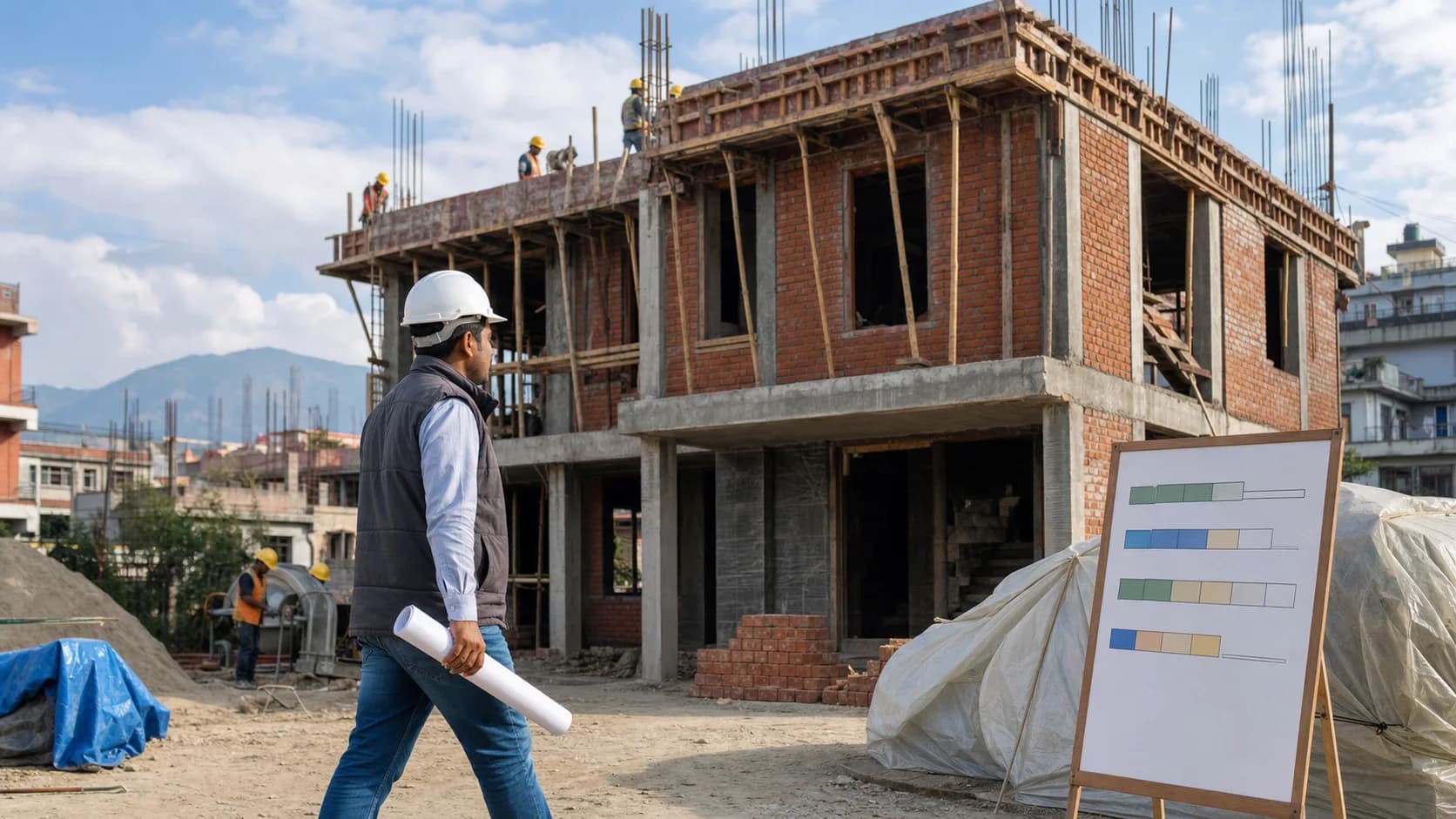
The most common planning mistake Nepal homebuilders make is starting construction with an unrealistic timeline in mind. Most people assume a house can be built in 8-10 months. The reality for a standard 2-floor, 3BHK home in Kathmandu Valley is typically 14-18 months from the moment you engage an architect, and 12-15 months from the day construction begins.
If you are planning around a specific date - a child starting school, a lease ending, a wedding - you need accurate numbers. This guide gives you those numbers, phase by phase, along with the most common causes of delay and how to mitigate them.
The Phases of House Construction in Nepal
A complete build in Nepal goes through seven main phases. Each has a realistic duration range depending on size, complexity, and how well the project is managed.
Phase 1: Design and Permit (8-16 weeks)
Before a single brick is laid, you need approved drawings and a building permit. This phase is chronically underestimated.
Activities:
- Client brief and site survey
- Architectural design (floor plans, elevations, sections)
- Structural design (foundation, column-beam schedule, slab details)
- Municipality building permit submission
- Municipality review and approval
Typical duration: 8-16 weeks
What causes delays:
- Multiple design revisions (budget 3-4 rounds if you are working with a new architect)
- Municipality review backlogs (KMC can take 4-8 weeks; smaller municipalities sometimes faster, sometimes slower)
- Incomplete document submissions requiring resubmission
- Land classification issues discovered late (see our permit guide)
What you can do: Start the design process as early as possible - ideally before you think you are ready. You can refine design while the permit is in review.
Phase 2: Site Preparation (1-2 weeks)
Once the permit is approved and your contractor is mobilized, site prep begins.
Activities:
- Site clearing and demolition (if existing structure)
- Setting out (marking building footprint on ground)
- Temporary site office and materials storage setup
- Soil testing if not already completed
Typical duration: 1-2 weeks
Note: If soil testing reveals poor bearing capacity (common in Kathmandu's alluvial plains), foundation design may need modification. Build in an extra 1-2 weeks for this.
Phase 3: Foundation and Substructure (4-8 weeks)
The foundation phase is heavily weather-dependent and site-condition dependent.
Activities:
- Excavation (manual or mechanical, depending on site access)
- Foundation concrete pour (raft, strip, or pile depending on soil)
- Curing period (minimum 7 days before loading the foundation)
- Plinth beam construction
- Damp-proof course (DPC) application
Typical duration: 4-8 weeks
What causes delays:
- Unexpected groundwater or poor soil at depth
- Underground utilities or previous structures discovered during excavation
- Monsoon flooding if you start between June and September
- Concrete curing delays if weather is too hot or too cold
What you can do: Ideally, begin foundation work outside monsoon season (October-May is best). If you must work during monsoon, ensure your contractor has proper dewatering equipment.
Phase 4: Structure - Columns, Beams, and Slabs (10-18 weeks)
This is the most visible phase and the one that takes longest for multi-floor buildings. For a 2-floor build, you go through two complete cycles of columns, beams, and slabs.
Per-floor cycle:
- Columns: shuttering, reinforcement, pour, cure (2-3 weeks per set of columns)
- Beams and slab: shuttering, reinforcement, pour, cure (2-3 weeks per floor)
- Minimum 21-day wait before removing slab formwork (often ignored by contractors)
Typical duration per floor: 5-8 weeks Total for 2-floor build: 10-16 weeks
What causes delays:
- Shuttering and centering shortages (common if your contractor is managing multiple projects)
- Steel or cement supply delays
- Rain during pour days (concrete cannot be poured in heavy rain)
- Skipping or shortening curing periods to accelerate schedule
What you can do: Ensure your contract specifies proper curing periods. Any shortcut here reduces structural strength and creates long-term problems.
Phase 5: Masonry and Plaster (8-12 weeks)
Once the structural frame is complete, brick infill walls go up, followed by internal and external plaster.
Activities:
- Brick infill walls on all floors
- Door and window frames
- Internal plaster (2 coats: rough and finish)
- External plaster and weatherproofing
- Parapet construction and waterproofing
Typical duration: 8-12 weeks
What affects duration:
- Number of rooms and complexity of layout
- Finish level (POP finish for ceilings adds 2-3 weeks)
- Weather (external plaster should not be done in heavy rain or direct summer sun)
Phase 6: MEP (Mechanical, Electrical, Plumbing) Rough-In (4-6 weeks)
In Nepal construction, plumbing and electrical rough-in work happens in two stages: rough-in (before plaster) and fit-out (after plaster). The rough-in phase installs concealed pipes and conduits.
Activities:
- Concealed plumbing: drainage, water supply, vent stacks
- Concealed electrical: conduits, boxes, main distribution board
- Solar water heater provisions (common in Kathmandu)
- Inverter/backup power provisions
Typical duration: 4-6 weeks (runs partly in parallel with Phase 5)
What causes delays:
- Coordination between mason and plumber (very common in Nepal - each trade works independently without coordination)
- Changes to room layouts after walls are partially built
Phase 7: Finishing (10-16 weeks)
Finishing is the most variable phase in both duration and cost. This is where the difference between a standard and premium build is most visible.
Activities:
- Floor tile installation (every room)
- Wall tiles (bathrooms, kitchen)
- Electrical fit-out: switches, sockets, fixtures, NEA connection
- Plumbing fit-out: sanitary ware, kitchen sink, water heater
- Doors and windows: frames, shutters, hardware
- Woodwork: wardrobes, kitchen cabinetry, staircases
- Ceiling: basic plaster or decorative/false ceiling
- Paint: internal and external
- Compound wall and gate
- Final clean and snagging
Typical duration: 10-16 weeks
What makes it longer:
- Custom woodwork (kitchens, wardrobes) takes 6-8 weeks if made locally
- Premium flooring (marble, engineered wood) requires more careful installation
- Multiple rounds of paint corrections
Choose your palette before painting starts. Use our house colour combinations guide for Nepal to shortlist shades, then try them on a photo in the paint visualizer. Confirm with a physical test patch so colour decisions do not hold up the finishing work.
Complete Timeline Summary
| Phase | Standard Build | Complex / Premium |
|---|---|---|
| Design and permit | 8-14 weeks | 12-20 weeks |
| Site preparation | 1-2 weeks | 1-3 weeks |
| Foundation | 4-8 weeks | 6-10 weeks |
| Structure (2 floors) | 10-16 weeks | 14-20 weeks |
| Masonry and plaster | 8-12 weeks | 10-16 weeks |
| MEP rough-in | 4-6 weeks (concurrent) | 5-8 weeks |
| Finishing | 10-14 weeks | 14-20 weeks |
| Total from design start | 14-18 months | 18-26 months |
| Total from construction start | 10-14 months | 14-20 months |
The Monsoon Factor
Nepal's monsoon season (June to September) affects outdoor construction significantly, but not uniformly:
Most affected by monsoon:
- Excavation and foundation work (flooding, waterlogged soil)
- External masonry and plaster (needs dry conditions)
- Concrete pours during heavy downpours (rain dilutes the mix)
Largely unaffected by monsoon:
- Indoor masonry and plaster work
- Structural framing (can continue if rain is not heavy)
- MEP rough-in work
- Most finishing work
A well-managed project can continue through monsoon by scheduling affected activities outside monsoon windows and continuing with protected indoor work during monsoon.
An unmanaged project loses 3-4 months to monsoon delays.
What Causes Projects to Run Late in Nepal
Based on our experience across hundreds of builds, the most common causes of delay in Nepal construction are:
-
Late permit start. Homeowners start thinking about design after the land is purchased, but start the permit process only when they want to break ground. The 3-4 month permit process is a fixed minimum.
-
Material supply delays. Cement, steel, and bricks are generally available in Kathmandu Valley, but specialty items (imported tiles, hardware, custom woodwork) can take 4-8 weeks to source. Order early.
-
Contractor managing multiple sites. If your contractor is managing 3-5 projects, your site gets shared attention. You may have skilled labour on your site some days and none on others.
-
Skipped curing periods. A contractor who skips 7-day curing to move faster will actually create long-term problems (cracking, repairs) that cause longer delays later.
-
Design changes mid-construction. Changing a wall location, adding a room, or upgrading finishes mid-build causes cascading delays. Finalize design completely before construction starts.
How to Plan Realistically
If you want to move into your home by December 2027, you need to:
- Start the design process by October 2026 (permit submission by December 2026)
- Break ground by March-April 2027 (after permit approval)
- Target construction completion by November-December 2027
Build a 6-8 week buffer into your plan. Projects that run exactly on schedule are unusual. Projects that run 6-8 weeks late with good management are common.
Use our construction timeline planner to generate a personalised phase schedule based on your floor count, build size, and planned start date.
How Gharpurja Manages the Timeline
Every Gharpurja project uses a project management system with:
- A baseline schedule agreed before construction starts
- Weekly progress reports showing actual vs. planned progress
- A site supervisor on your site 6 days per week
- Proactive material ordering to prevent supply delays
- Full permit management to prevent the most common pre-construction delay
We cannot guarantee zero delays - Nepal construction has genuine variables beyond anyone's control. But we give you accurate expectations, and when delays happen, we tell you immediately and give you a revised plan rather than hoping you do not notice.
Contact us to discuss your project timeline or try our timeline planner for a phase-by-phase estimate.