
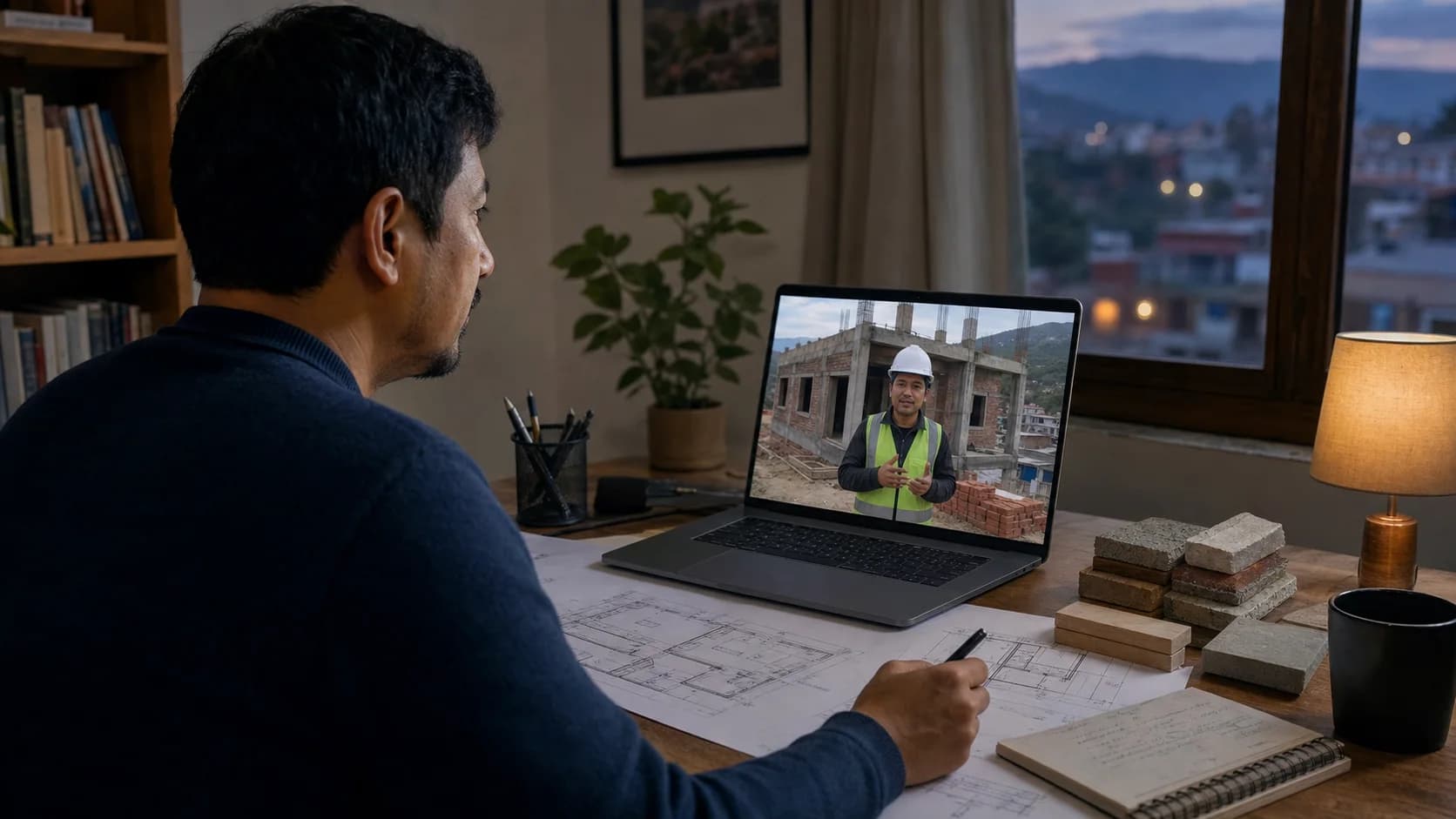
You have been saving for years. You work double shifts in Osaka, or you put in long weeks in Dubai, or you manage your expenses carefully in Sydney. You send money home every month. The plan has always been the same: build a house for your parents, or build one for yourself for when you eventually come back.
You bought a piece of land in Kathmandu three years ago. You have the Lalpurja in a folder. You have done the math. You know roughly what it will cost. You have even looked at floor plans online.
What you do not have is a plan for how to actually manage this build without being there.
That absence - the 5,000 kilometres, the time zone difference, the inability to walk onto a site on a Tuesday morning - is the single biggest reason that NRN construction projects go wrong. Not the money. Not even the design. The distance.
This guide is specifically written for Nepalis living abroad who are planning to build a home in Nepal. Everything in here addresses the specific challenges of managing construction remotely.
What Actually Happens When NRNs Try to Build
Most Nepalis abroad approach the problem the same way: they appoint a trusted family member - a sibling, a cousin, a parent - to supervise the construction. They wire money in instalments. They visit once or twice if they can.
This approach has a poor success rate. Not because the family member is not trustworthy - they almost always are. The problem is different.
The Family Supervisor Problem
Your cousin may be the most honest person you know. But managing construction requires:
- The ability to read and verify structural drawings
- Knowledge of material specifications and the ability to identify substandard deliveries
- The authority to challenge a contractor who is cutting corners
- The time to be on-site at least several days per week
- Experience with how Nepal's construction industry works
Your cousin likely has none of these skills, and is also trying to maintain their own job and family responsibilities. What happens in practice: they visit occasionally, the contractor reassures them everything is fine, they relay that reassurance to you, and work continues at whatever pace and quality the contractor chooses.
The contractor is not necessarily dishonest. He is rational. He knows there is no real oversight. He knows the client is abroad and will not visit for months. He prioritises his other projects, or his more demanding clients, or simply slows down because no one is watching.
The Money Problem
The most common financial complaint from NRN builds: "I sent NRs 40 lakhs. I am not sure where it went. The house is only at second-floor slab level."
Money sent from abroad often moves through multiple people before it reaches the contractor or the site. Your uncle collects it. He pays the contractor in parts. The contractor sometimes buys materials directly. Sometimes your uncle buys materials. No one is keeping systematic records.
By the time you want to audit - when something goes wrong, or when the money runs out before the house is done - there is no clear accounting. The contractor has one story. Your uncle has another. The receipts are missing or incomplete.
The Visit Shock
Many NRNs come back to Nepal once a year, or every 18 months. They visit the site. What they find is often not what they expected.
The house exists. But:
- The floor finish is not what was agreed
- A bathroom is in the wrong place
- The compound wall is shorter than specified
- The electrical points are in awkward locations
- There is visible cracking in one of the walls
- The timeline has slipped by 8 months and there is no clear end date
By the time you are standing on the site seeing these things, most of them are unfixable without demolishing work. The concrete is set. The tiles are grouted. The walls are plastered.
This is the most painful version of the story - not fraud, not dishonesty, just a complete failure of communication and oversight over 18 months.
The Specific Risks of Managing Construction From Abroad
Here is a clear breakdown of what goes wrong and why. Each of these is a structural risk, not a matter of choosing the wrong contractor.
1. No Real-Time Oversight
A contractor's quality and pace is directly correlated with how closely he is supervised. This is not a moral judgement - it is how every human workplace functions. A construction site where the client shows up daily gets different quality than one where the client shows up twice a year.
When you are abroad, there is no substitute for a professional site supervisor who is physically present, qualified to assess the work, and empowered to stop and reject substandard work.
2. Information Asymmetry
You know what the contract says. The contractor knows what is actually happening on site. Everything in between is filtered - through your family, through phone calls, through photos that are selected to show progress and hide problems.
You are making financial decisions - sending more money, approving schedule changes, signing off on phases - based on incomplete and curated information.
3. Legal and Documentation Gaps
Building permits, municipality inspections, material certifications, concrete cube tests, structural completion certificates, gharpurja processing - each of these requires someone present in Nepal to manage.
Who is handling this for you? If the answer is "the contractor," the contractor is handling it in his interest, not yours.
4. Currency and Payment Exposure
Nepal Rastra Bank regulations govern how funds can be sent from abroad for construction purposes. Many NRNs send money through informal channels (hundi or direct bank transfer to personal accounts) without understanding the implications for future property registration and gharpurja processing.
Payments made outside formal banking channels can create problems when you later try to establish ownership formally.
5. Design Drift
Over a long build, dozens of small decisions get made on-site. A wall is moved slightly. A window size is changed. A material is substituted. Each decision is small. Collectively, they can change the house significantly from what was designed.
Without a site supervisor who is accountable to the original design, these changes accumulate. By the time you see the house, it is a version of what you wanted, not what you agreed.
What You Actually Need: A Professional Remote Build System
Building from abroad is not impossible. It requires a specific type of construction partner and a specific type of process. Here is what that looks like.
Consistent Documentation
You need weekly photo and video reports from the site. Not a WhatsApp photo of the front wall once a month. A systematic report covering:
- Work completed this week (with photos of each element)
- Materials received (quantity, brand, quality check result)
- Issues encountered and how they were resolved
- Next week's planned activities
- Any decisions requiring your input
This report should come from your construction company's site supervisor, not from the contractor. Those are two different people with different loyalties.
Transparent Milestone-Based Payments
Your payments should be tied to verifiable, objective construction milestones. A typical structure:
| Milestone | Payment |
|---|---|
| Contract signing | 10-15% |
| Foundation completion (verified) | 20% |
| First-floor slab completion (verified) | 15% |
| Second-floor slab completion (verified) | 15% |
| Roof slab completion (verified) | 10% |
| Plastering completion | 10% |
| Finishing completion | 10% |
| Handover with defects resolved | 5% |
"Verified" means your site supervisor has confirmed the milestone is complete, not that the contractor has told you it is. The payment releases only after confirmation.
Direct Communication Without Middlemen
You should be able to reach your project manager directly via WhatsApp or email. Not through a relative, not through a third party. Questions should be answered within 24 hours. Decisions should be documented in writing.
A Fixed-Price Contract
When you are abroad, you cannot respond quickly to "unforeseen cost" claims. A contractor who can generate change orders freely will generate them freely. A fixed-scope, fixed-price contract protects you from this. Variations should only happen with your written approval and explicit cost agreement.
Legal Compliance From Day One
The permit, the structural certifications, the municipality inspections, the gharpurja process - all of this needs to be managed by your construction partner, with you kept informed at each step. If these are handled informally, your property rights may not be fully secured when you come back.
How Gharpurja Serves NRN Clients Specifically
We build homes across Nepal for clients both in-country and abroad. Our NRN clients are some of our longest-term relationships, precisely because getting this right requires genuine commitment, not just good intentions.
Here is how our process works for an NRN build:
Step 1: Remote Consultation
Your first conversation with us happens over video call. You tell us about your land, your family's requirements, your budget, your timeline. We ask specific questions: Who will be available in Kathmandu for document-related tasks? What is your budget in NRs? When do you hope to move in or have the house ready?
We give you an honest, specific preliminary assessment within 5 working days: what the build will likely cost, how long it will take, what steps need to happen first. If anything about your situation creates complications, we tell you at this stage, not halfway through the build.
Step 2: Design With Your Input
Our architects design your floor plans through an iterative process. You review each version via PDF or video walkthrough. We build 3D visualisations so you can see the house before a single column is poured. Revisions happen over video call.
We ask the questions your floor plan needs answered: How many family members will live here permanently? Will elderly parents be living on the ground floor? Do you need a puja room? A home office? A ground-floor shop space? The questions that matter for a Nepal family home, asked by people who know what Nepal family homes require.
Step 3: Permit and Legal Setup
We handle the building permit application in full. You grant us power of attorney for permit-related matters - a straightforward legal process we can explain to you and which your family lawyer in Nepal can verify.
We manage:
- Land classification verification
- Municipal building permit application and follow-up
- All government office visits
- Permit fee payment (invoiced to you transparently)
You receive a copy of the approved permit via email.
Step 4: Construction With Weekly Reporting
Once construction begins, you receive a weekly report every Sunday. This contains:
- Photographs of all work completed that week (20-40 photos minimum)
- Video walkthrough of the current floor or section
- A written summary: work done, materials used, milestone progress
- A 3-4 week lookahead: what will be done in the coming weeks
- A budget tracker showing cumulative spend against your BOQ
You can WhatsApp our project manager directly with any question. You get a reply within 24 hours, always.
Step 5: Milestone Verification Before Payment Release
We never ask for the next payment instalment without first sending you verified documentation of the completed milestone. You see the foundation photos before we ask for the next payment. You see the slab completion report before the next transfer.
Payments can be made via formal remittance channels (bank transfer to our company account with official receipts issued), which protects your property rights at gharpurja time.
Step 6: Gharpurja Processing
At construction completion, we manage the full gharpurja process: final municipality inspection, completion certificate, Land Revenue Office filing, and issuance of the gharpurja document. You receive a scanned copy via email as soon as it is issued, and the original is held safely until you collect it.
The gharpurja is in your name (or the names you specified). Your investment is legally secured.
What an NRN Build Actually Costs With Gharpurja
Our pricing for NRN clients follows the same structure as in-country builds. The additional services (weekly reporting, remote consultation, full permit management, power of attorney filing) are not charged as extras - they are part of our standard service.
A typical 3BHK, 2-floor home in Kathmandu Valley on 5-6 Aana land:
- Construction cost (standard finish): NRs 1.0-1.5 crore
- Municipality permits: NRs 70,000-1,50,000
- Gharpurja processing: NRs 1,00,000-2,50,000 (includes Land Revenue Office fees)
- Total project cost (construction plus all fees): NRs 1.2-1.9 crore
Use our cost estimator to get a more specific figure for your land size and preferred finish level.
Practical Checklist for NRNs Planning a Build
Before you engage any construction company, have these things in place:
Land and legal:
- Confirmed land classification (Aabadi, not Krishi)
- Up-to-date Lalpurja with your name (or your name plus family members)
- Parcel map (napi naksha) from Survey Department
- No active boundary disputes with neighbours
- Decided who will hold power of attorney in Nepal for permit matters
Design:
- Clear brief: number of bedrooms, floors, special requirements
- Budget agreed and held in savings (do not commit to building if the money is not already saved)
- Approximate timeline (when do you want to be able to use the house?)
Financial:
- Funds available to transfer through official banking channels
- Understanding of Nepal Rastra Bank rules for foreign currency remittance for property
- Company bank account details confirmed (not personal account of contractor)
Communication:
- Direct contact with your project manager (not through a third party)
- Weekly reporting schedule agreed
- Decision-making protocol: which decisions can the site team make independently, which require your approval?
The Question We Hear Most Often
"Can I trust you? I am sending lakhs of rupees from abroad. How do I know you will deliver?"
This is the right question to ask any construction company. Here is what we tell our NRN clients:
We have been building homes in Nepal for 15 years. Our NRN clients include families who built from Australia, the UK, the US, Japan, Qatar, and Malaysia. Our business depends on those families telling other families about us - the construction industry in Nepal runs largely on referrals.
Every Gharpurja contract includes a fixed price with a written payment schedule. We have never asked a client for payment without showing them verified proof of the preceding milestone. We handle the gharpurja process for every client because if we do not, it means the build is not done properly from a legal standpoint.
But we know that words on a page do not build trust. Our first recommendation to any prospective NRN client is: call one of our previous NRN clients before you sign anything with us. We will give you names and contact details. Talk to them directly. Ask them what went right, what went wrong, and whether they would use us again.
That conversation will tell you more than anything we can say here.
Contact us to start a conversation, or try our cost estimator to get a preliminary budget for your project.