
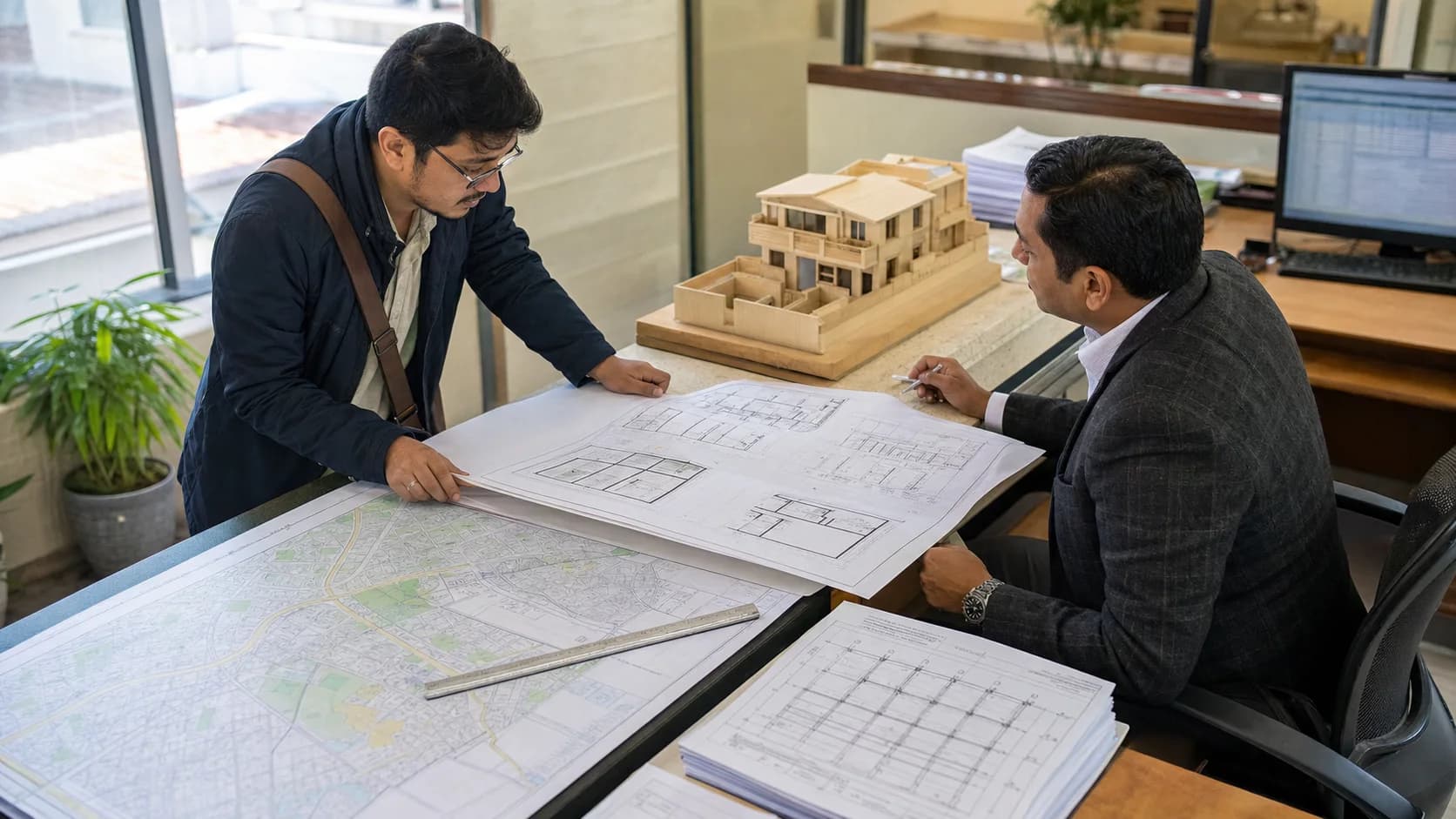
Nepal has one of the more complicated building permit systems in South Asia. Between land classification checks, structural approvals, multiple municipality offices, and the final gharpurja certificate, the process involves at least 8 separate steps and can take anywhere from 3 to 12 months depending on your municipality and how prepared you are.
Most construction delays in Nepal happen not because of the building itself - but because the owner did not start the permit process early enough, or submitted incomplete documents, or chose the wrong land-use category.
This guide walks through the complete process: what you need, where you go, how long it takes, and what trips people up.
What Is a Building Permit in Nepal?
A building permit (commonly called "naksha pass" in Nepal, from the Nepali word for blueprint) is official approval from your local government body - typically the municipality, sub-metropolitan, or metropolitan city office - to begin construction.
Without a building permit:
- Your construction is technically illegal
- You cannot get a house ownership certificate (gharpurja) at the end
- You cannot use the building as bank collateral
- The municipality can demolish the structure
- You may face fines and stop-work orders at any time
This is not a formality you can skip. And yet many homebuilders in Nepal start construction without it - often because they think it is too complicated, too expensive, or too slow. This guide will remove that excuse.
Step 1: Verify Your Land Classification
Time required: 1-2 weeks
Before any permit application, you must confirm that your land is classified as Aabadi (residential), not agricultural (krishi) land.
- Check your Lalpurja (land ownership certificate) - the category is listed there
- If it says "Krishi" or any agricultural category, you must convert it before building
- Apply to your District Administration Office (DAO) or local government for land-use conversion
- Conversion adds 2-6 months and a fee (typically NRs 5,000-25,000 depending on size)
Required documents at this stage:
- Original Lalpurja
- Trace map / field map from Land Revenue Office
- Citizenship certificate of owner(s)
Step 2: Complete Land Survey and Boundary Demarcation
Time required: 2-4 weeks
Before submitting building plans, you need an up-to-date parcel map and confirmed boundary demarcation.
- Hire a licensed surveyor to confirm your plot boundaries
- Get a certified copy of the parcel map (napi naksha) from the Department of Survey
- Resolve any boundary disputes with neighbors now - disputes that appear mid-permit process delay everything
Important: Disputes with neighbors about boundaries are one of the top reasons permit applications get held up. Resolve these before you start anything else.
Step 3: Prepare Your Design and Structural Drawings
Time required: 4-8 weeks (depends on design complexity)
Your permit application must include complete architectural and structural drawings. These must be prepared by licensed professionals.
Architectural drawings required:
- Site plan showing building placement and setbacks
- Floor plans for each floor
- Elevations (all four sides)
- Section drawings
- Roof plan
Structural drawings required:
- Foundation plan with footing details
- Column and beam schedule
- Slab reinforcement details
- Structural calculations (for buildings over 3 floors or in risk areas)
Who must sign the drawings:
- Licensed Architect (Nepal Engineering Council registered, Architecture category)
- Licensed Civil/Structural Engineer (Nepal Engineering Council registered)
Without proper licensing on both architects and engineers, the municipality will reject the application.
Step 4: Check Local By-Laws and FAR Limits
Time required: 1-3 days (but can cause major design changes)
Before finalizing drawings, your architect must confirm:
- Setback requirements: Minimum distance from building to plot boundary varies by municipality. Kathmandu Metropolitan City (KMC) typically requires 1.5-2 metres on side and rear boundaries.
- FAR (Floor Area Ratio): The total built-up area you are allowed depends on the FAR for your zone. In KMC, residential FAR is typically 1.5-2.5. On a 5 Aana plot (1,711 sqft), you can build 2,567-4,278 sqft total.
- Height limits: Most municipalities cap residential buildings at 8-11 metres in residential zones.
- Ground coverage: Maximum percentage of plot that can be covered by the building footprint.
If your design exceeds these limits, it must be revised before submission. Getting this wrong at the drawing stage costs weeks.
Step 5: Submit the Building Permit Application
Where to go: Your local municipality office (ward office, then main office)
Key documents for the application package:
| Document | Source |
|---|---|
| Completed permit application form | Municipality office |
| Lalpurja (land certificate) - certified copy | Land Revenue Office |
| Trace map / parcel map - certified copy | Survey Department |
| Architectural drawings (signed by licensed architect) | Your architect |
| Structural drawings (signed by licensed engineer) | Your structural engineer |
| Citizenship certificate of owner | Owner |
| Site plan showing plot, building footprint, setbacks | Architect |
| Property tax clearance certificate | Revenue section of municipality |
| Ward membership letter (in some municipalities) | Ward office |
Some municipalities additionally require:
- No-objection letters from neighbors if building close to shared boundaries
- Environmental clearance for buildings above a certain size
- Fire safety plan for larger buildings
Fees at submission: Depends on municipality and plot size. For KMC, expect NRs 50,000-2,00,000 in government fees. Other municipalities are typically lower.
Step 6: Municipality Technical Review
Time required: 2-8 weeks
The municipality's engineering/technical section reviews your drawings for:
- Compliance with local by-laws (setbacks, FAR, height)
- Structural adequacy (for buildings over 3 floors, or in flood/risk zones)
- Site plan accuracy
- License validity of architect and engineer
Common reasons for rejection or correction requests:
- Setback violations (very common - design slightly too close to boundary)
- FAR exceeded
- Structural drawings not matching architectural drawings
- Missing engineer or architect license details
- Ownership mismatch between drawings and Lalpurja
- Incomplete or uncertified documents
If corrections are needed, you resubmit. Each resubmission cycle adds 2-4 weeks.
Tip: Having your architect submit the application rather than doing it yourself dramatically reduces back-and-forth. An experienced architect knows exactly what each municipality wants and avoids the most common errors.
Step 7: Construction Begins - and Inspections
Once your permit is approved, construction can begin. But the permit process does not end at approval.
Most municipalities require inspection at key stages:
- Foundation inspection before pouring concrete
- Structural inspection at each floor slab
- Final inspection at building completion
Missing an inspection can invalidate your permit or delay the gharpurja certificate at the end.
Keep a copy of the permit on-site at all times. Inspectors can and do visit unannounced.
Step 8: Get the Gharpurja Certificate
Time required: 4-8 weeks after construction completion
The gharpurja (also called "jagga ghar darta" or property registration certificate) is the final ownership certificate that includes both the land and the completed building. It is issued by the Land Revenue Office after construction is complete and inspected.
Process:
- Apply to your municipality for a "house completion certificate" after final inspection
- With the completion certificate, apply to the Land Revenue Office for gharpurja
- The Land Revenue Office will send a field officer to verify the building
- After verification, the gharpurja is issued
Gharpurja fees: Based on property value (estimated by the Revenue Office), typically 2-4% of assessed value. Budget NRs 50,000-3,00,000 depending on location and size.
Why gharpurja matters:
- It is your legal proof of ownership of the completed building
- Required for bank loans using the property as collateral
- Required to sell the property
- Required for utility connections
- Required for inheritance and succession
Total Timeline Overview
| Phase | Typical Duration |
|---|---|
| Land classification verification | 1-2 weeks |
| Survey and boundary demarcation | 2-4 weeks |
| Architectural and structural drawings | 4-8 weeks |
| Building permit application and review | 4-10 weeks |
| Construction (2-floor standard build) | 12-18 months |
| Final inspection and completion certificate | 2-4 weeks |
| Gharpurja issuance | 4-8 weeks |
| Total from start to gharpurja | 18-26 months |
The biggest variable is the building permit review timeline. In Kathmandu Metropolitan City, the formal process can take 4-6 weeks if documents are complete. In smaller municipalities with fewer technical staff, it can take 2-3 months.
Why Most Homebuilders Struggle With Permits
The honest reason: the system requires you to coordinate between the Land Revenue Office, Survey Department, Nepal Engineering Council, and your municipality - all of which have different working hours, different queues, and different requirements.
Most homebuilders do not have time to do this on top of managing their regular work. And most contractors either do not handle permits at all, or handle them informally (which creates risk at the gharpurja stage).
At Gharpurja, handling the complete permit process from application to gharpurja certificate is part of every construction package we offer. You never have to enter a government office. We manage every stage and keep you informed at each milestone.
View our permit guide tool for a detailed checklist, or contact us to have us manage the entire process for you.