
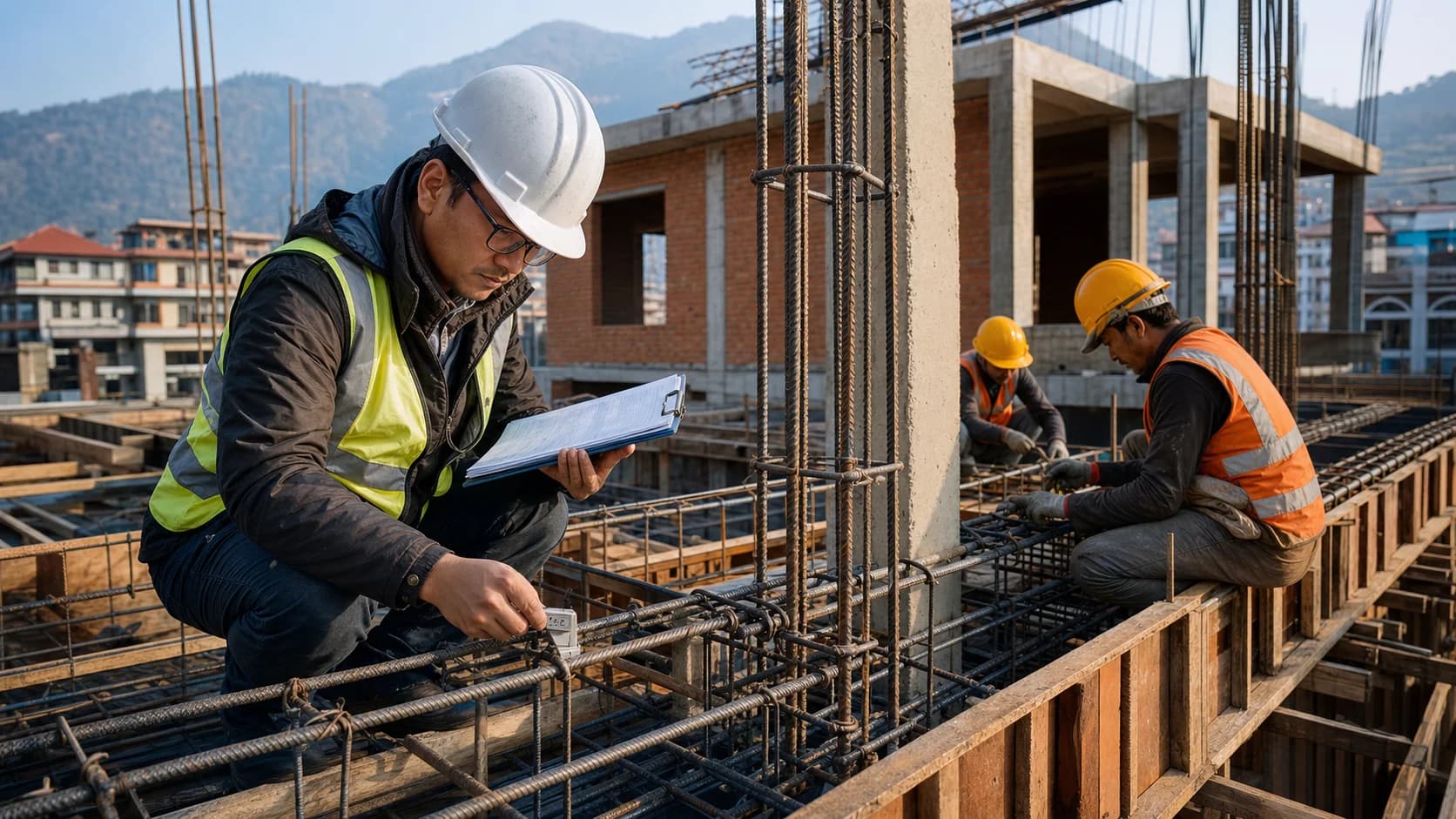
On April 25, 2015, a 7.8 magnitude earthquake killed 8,964 people in Nepal. A subsequent 7.3 magnitude aftershock on May 12 killed hundreds more. The damage was catastrophic, but it was not random. Analysis by engineers after the disaster showed a clear pattern: buildings that collapsed were almost universally load-bearing brick masonry structures built without structural engineering. Buildings that survived - even those adjacent to collapsed ones - were almost universally RCC (Reinforced Cement Concrete) frame structures built to Nepal's seismic code.
Nepal is in seismic Zone V - the highest risk zone. If you are building a home here, earthquake resistance is not a premium feature. It is a baseline requirement. This guide explains exactly what that means in practice, and what your contractor must do - and often skips.
RCC Frame vs. Load-Bearing Masonry: The Critical Distinction
The single most important decision in Nepal construction is your structural system.
Load-Bearing Masonry
In this system, the weight of the building is carried by brick walls. The walls are structural. If the walls fail - due to shaking, poor mortar, or foundation movement - the building collapses.
Load-bearing masonry is:
- Cheaper to build (no structural engineer required, simpler construction)
- Faster to build for simple single-floor structures
- Extremely dangerous in seismic zones
- Responsible for the majority of deaths in Nepal earthquakes
Many contractors still build load-bearing masonry in Nepal. It is still legally permitted for single-storey structures in some zones. But for any multi-storey home - and frankly, for any home in Nepal - it is not the right choice.
RCC Frame Construction
In this system, the building weight is carried by a concrete frame: columns (vertical) and beams (horizontal) with reinforced steel bars inside. The brick walls between columns are infill walls - they carry no structural load. If the infill walls crack or fail, the frame holds. If the frame is properly designed and built, the building does not collapse.
RCC frame with proper seismic detailing is:
- The Nepal Building Code (NBC) standard for multi-storey residential buildings
- Significantly more expensive than load-bearing masonry
- The system used in virtually all buildings that survived the 2015 earthquake intact
- What Gharpurja builds on every project
The cost difference is real: RCC frame construction adds roughly 15-20% to structural costs compared to load-bearing masonry. That is NRs 8-15 lakhs more on a typical 3BHK build. The reason to pay it is obvious.
What Nepal Building Code (NBC) Requires
The Nepal Building Code was significantly revised after the 2015 earthquake. The key standard is NBC 105: 2020 (Seismic Design of Buildings in Nepal).
For residential buildings in the Kathmandu Valley and other high-risk zones:
Reinforcement Requirements
- Steel grade: Fe500D (ductile) mandatory. The "D" suffix means the steel can deform significantly before breaking - critical for earthquake survival. Fe415 is no longer recommended for new construction.
- Column size: Minimum 230x230mm for residential buildings in Zone V. Most engineers specify 300x300mm or larger for structural safety margins.
- Beam depth: Minimum 230mm depth for primary beams.
- Reinforcement lap length: Must be at least 50 times the bar diameter.
Ductile Detailing at Joints
This is the single most technically critical element - and the one most commonly cut corners on by unqualified contractors.
The connection between columns and beams must be specially reinforced. In seismic design, the beam should fail before the column (the "strong column, weak beam" principle). This requires:
- Closely spaced stirrups (ring ties) at beam-column joints - typically at 75mm centres within the joint zone, vs. 150mm in mid-span
- Proper anchorage of beam bars into columns
- Confinement reinforcement in columns at floor levels
An unqualified mason will space stirrups uniformly - saving time but creating joints that are brittle in an earthquake.
Foundation Requirements
For Kathmandu Valley's soft alluvial soil:
- Soil testing is mandatory under NBC for any building above ground plus first floor
- Raft (mat) foundation is typically specified for soft soil conditions
- Foundation depth must reach stable bearing capacity soil
Materials That Make the Difference
Steel Bars
Use: Fe500D (ductile) grade TMT bars only.
Brands: Hulas, Panchakanya, Prakash are widely available in Nepal and produce consistent quality. Ask for mill certificates with each delivery. The certificate shows the actual tested yield strength of the batch.
What to watch for: Cheap steel bars that look identical to high-quality bars. The only reliable check is the certificate or a laboratory test. Some contractors substitute Fe415 bars (which have lower ductility) for Fe500D to save NRs 10-20 per kg - a meaningful saving on a multi-tonne order.
Cement
Use: OPC Grade 53 for all structural concrete.
Mix design: A proper structural concrete mix for Nepal conditions is typically M20-M25 grade (1:1.5:3 to 1:1:2 cement-sand-aggregate ratio by volume). Many contractors use "baas ko gathi" (a bamboo-cup measure) instead of a proper mix design. This produces inconsistent concrete strength.
For critical structural elements, specify laboratory-tested concrete from a batching plant where available.
Concrete Curing
This is the most commonly skipped quality step in Nepal construction.
Concrete gains 70% of its final strength in the first 7 days of curing - but only if it is kept wet. If it dries out prematurely (common in Nepal's dry season), strength development stops. A slab that should achieve 25 MPa may only reach 15 MPa.
What proper curing looks like:
- Slab and columns kept wet continuously for minimum 7 days (14 is better)
- Wet burlap or hessian sacks on all surfaces
- In hot weather, water twice daily or more
Many contractors will not tell you this is being skipped because they are in a hurry to move to the next pour. A site supervisor who can enforce curing schedules is essential.
Concrete Cube Tests
For any significant structural pour - foundation, columns, beams, slabs - request concrete cube tests. Cubes of concrete are poured from the batch and tested at 7 days and 28 days. This confirms the actual strength achieved.
Cube test kits are inexpensive. Many contractors resist them because a failing test creates accountability. Insist on them.
Six Things Your Contractor Must Do Correctly
These six elements are the most critical - and the most commonly compromised in Nepal construction.
- Use Fe500D bars (not Fe415). Verify with mill certificates on delivery.
- Space stirrups correctly at joints. 75mm centres within 2d of joints, not uniform 150mm throughout.
- Anchor beam bars properly into columns. The bar must be embedded by at least 50 bar-diameters.
- Cure all concrete for minimum 7 days. No exceptions for fast-tracking.
- Do not deviate from structural drawings. Any change to bar sizes, column dimensions, or joint details must be approved by the structural engineer in writing.
- Do not remove formwork too early. Slab formwork should stay in place for minimum 21 days. Column and beam formwork: 7 days minimum.
Retrofit: What If Your House Is Already Built?
If your existing house was built before 2015, or was built without structural drawings, you should have it assessed.
Nepal's National Reconstruction Authority (NRA) developed a post-earthquake rapid assessment system, but for a proper seismic assessment of your existing building, hire a structural engineer for a formal evaluation. Cost: NRs 20,000-60,000 depending on building size.
Common retrofit options for vulnerable buildings:
- Adding RC jacketing to columns (wrapping existing columns in new reinforced concrete)
- Adding shear walls
- Foundation underpinning in soft soil areas
Retrofitting is less effective than building right the first time, but significantly better than doing nothing.
Ask These Questions Before Hiring Any Contractor
Before signing any construction contract, ask:
- What structural system will you use? (Expected answer: RCC frame)
- What steel grade will you use? (Expected answer: Fe500D)
- Will you provide concrete cube test results? (Expected answer: Yes)
- Who is your structural engineer, and can I see their NEC registration? (Expected answer: A name and license number you can verify)
- What is your curing procedure for slabs? (Expected answer: 7-14 days of wet curing)
If a contractor cannot answer these questions clearly, he lacks the expertise to build safely in Nepal.
At Gharpurja, every project is designed by NEC-registered structural engineers and supervised by our own civil engineers on-site. We provide concrete cube test results and maintain a construction diary that you can review at any time.
Use our cost estimator to see how earthquake-resistant construction is costed, or contact us to discuss your project.